Classroom video for K-12 schools

Classroom video,only what the teacher chose.

Backpack Education is a video library for K-12 classrooms. Your district approves the videos, teachers choose from that list for each class, and students watch with no search, no suggestions, no comments and nothing playing next.

Teachers: start a free 14-day trial

See what Backpack leaves out of a video page
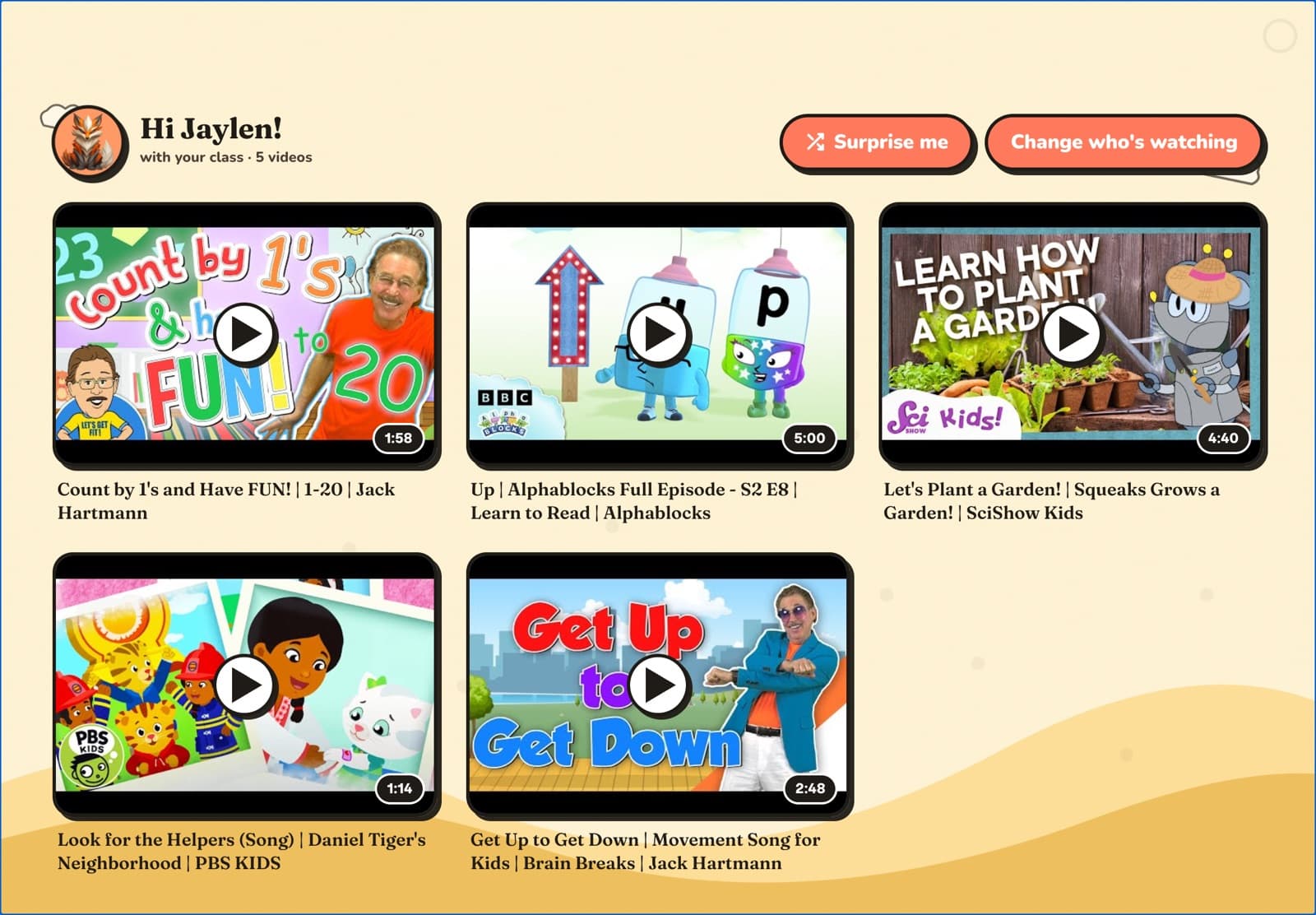
Hi Jaylen! with your class, 5 videos: the five videos Ms. Reed packed, with Surprise me and Change who's watching
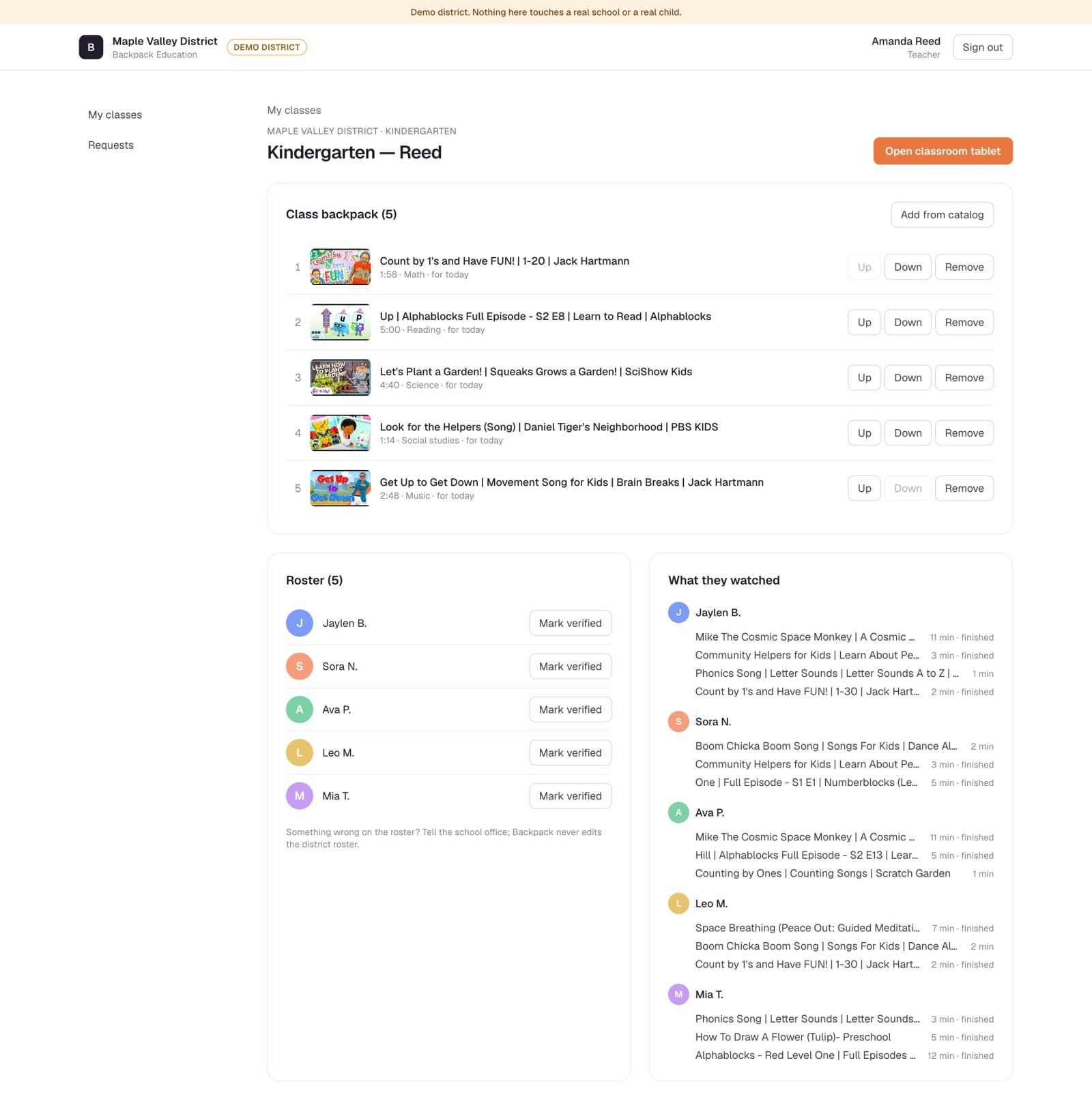
The teacher's class page for Kindergarten, Reed: an Open classroom tablet button and the class backpack of five videos, each with Up, Down and Remove

Real screens from our demo district. Names are demo data.

Who it is for

Built for districts, teachers and families.

Districts

One approved video list for every classroom, a log of every change, and the privacy paperwork ready for review.

Teachers

Choose the week's videos in about eight minutes and open the class with one tap. Nothing to install.

Families

See this week's class videos and what your own child watched, so you can ask about it at home.

What Backpack leaves out of a video page, and what your class still sees

Where most lessons start

One video, chosen by a teacher.

On a public video site, that video comes with search, suggestions, comments and more videos lined up to play next.

01 · Search

Children cannot search.

A child can't look anything up. They open what their teacher packed, and only that.

02 · Up next

Nothing plays next on its own.

Backpack never starts another video on its own. What comes after is the teacher's decision.

03 · Suggestions

Backpack suggests nothing.

What a child watched yesterday has no say in what they see today.

04 · Comments

There are no comments.

There are no comments to read and nowhere to write one.

05 · Accounts

Children do not have accounts.

On the classroom tablet a child taps their own name. There is no profile and no password to forget.

06 · The page around it

Nothing sits around the video.

No banners or promoted slots around the video, and no channel to wander into. Just the one thing the teacher wanted.

What remains · the real classroom tablet

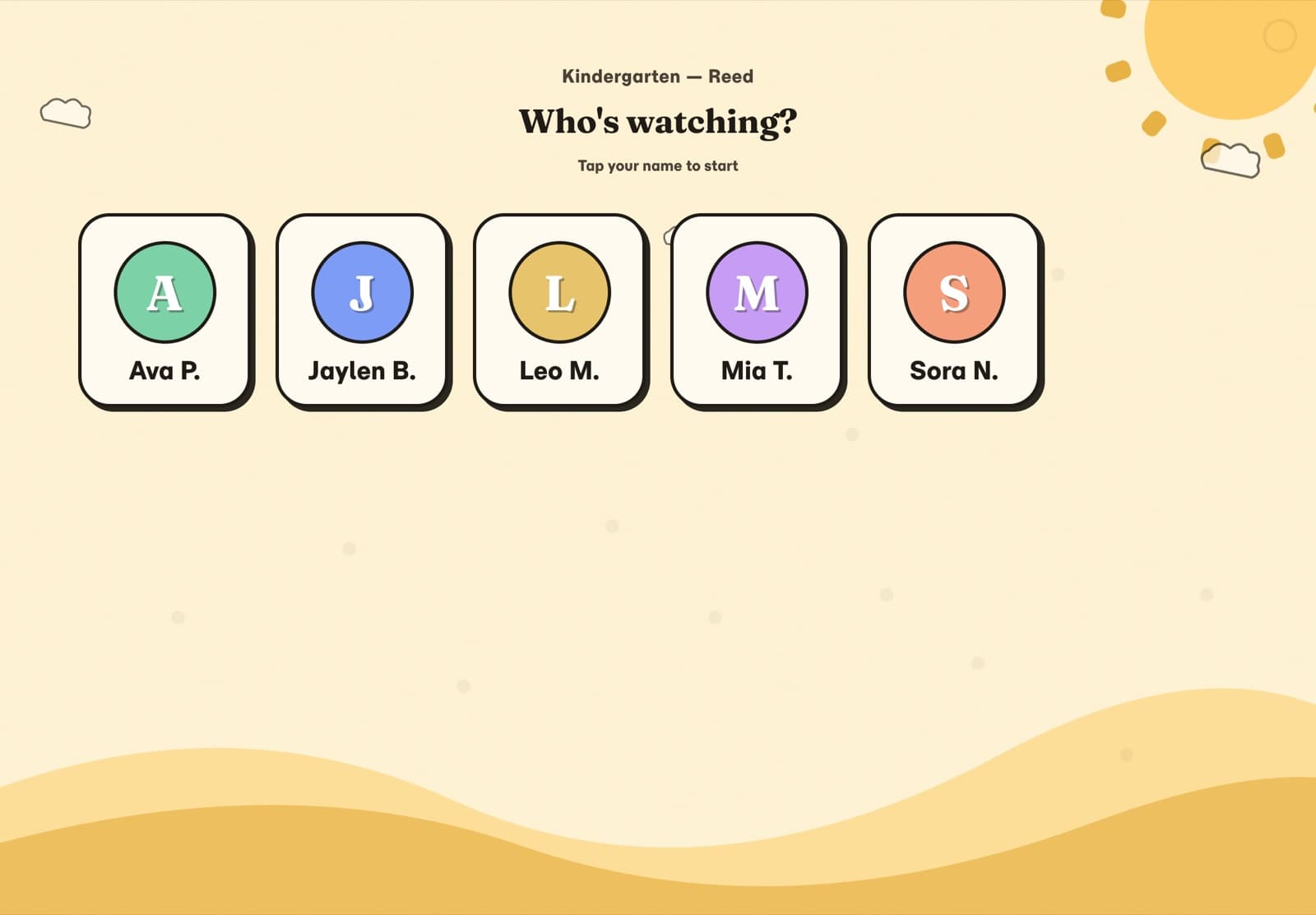
Who's watching?

The teacher opens the tablet. A child taps their name: first name, last initial, their colour. No photo.

Hi Jaylen

The child sees only what Ms. Reed chose.

Five videos for today, from the district's approved catalog. There is nothing else to find.

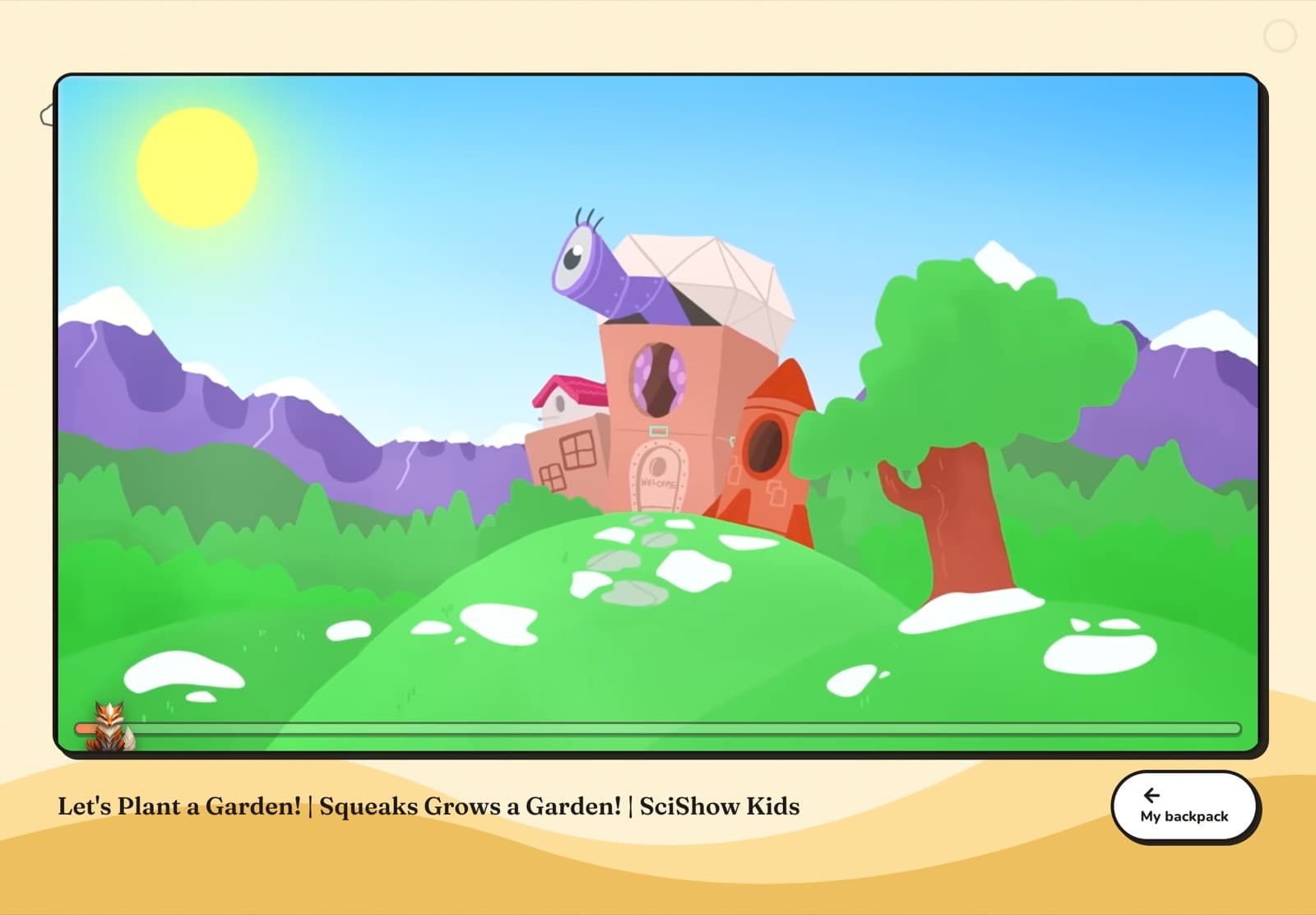
Watching

Backpack never starts another video on its own.

The kid player's only exit is "My backpack". How long Jaylen watched goes to Ms. Reed and his parent. No principal or district screen shows it.

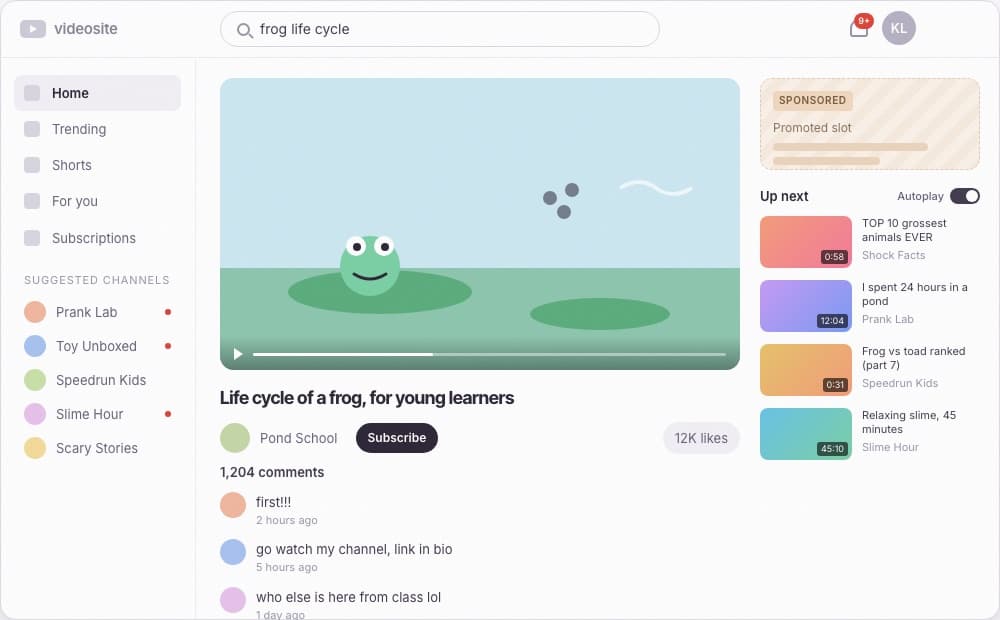
An illustrated, generic video site with search, an up next list with autoplay, suggested channels, comments, an account and a promoted slot around one video.
Before: the web today, a generic video site, illustrated.
  1. Search. Nothing to look up.
  2. Up next. Nothing plays on its own.
  3. Suggestions. No feed, no channels to follow.
  4. Comments. Nothing to read or write.
  5. Accounts. No sign-in for a six-year-old.
  6. The page around it. No banners, no rabbit hole.
Hi Jaylen! with your class, 5 videos: the five videos Ms. Reed packed, with Surprise me and Change who's watching
After: only what Ms. Reed packed. Real screen, classroom tablet, demo district.

Who decides what children watch

Three people decide what a class watches. A family can see the result.

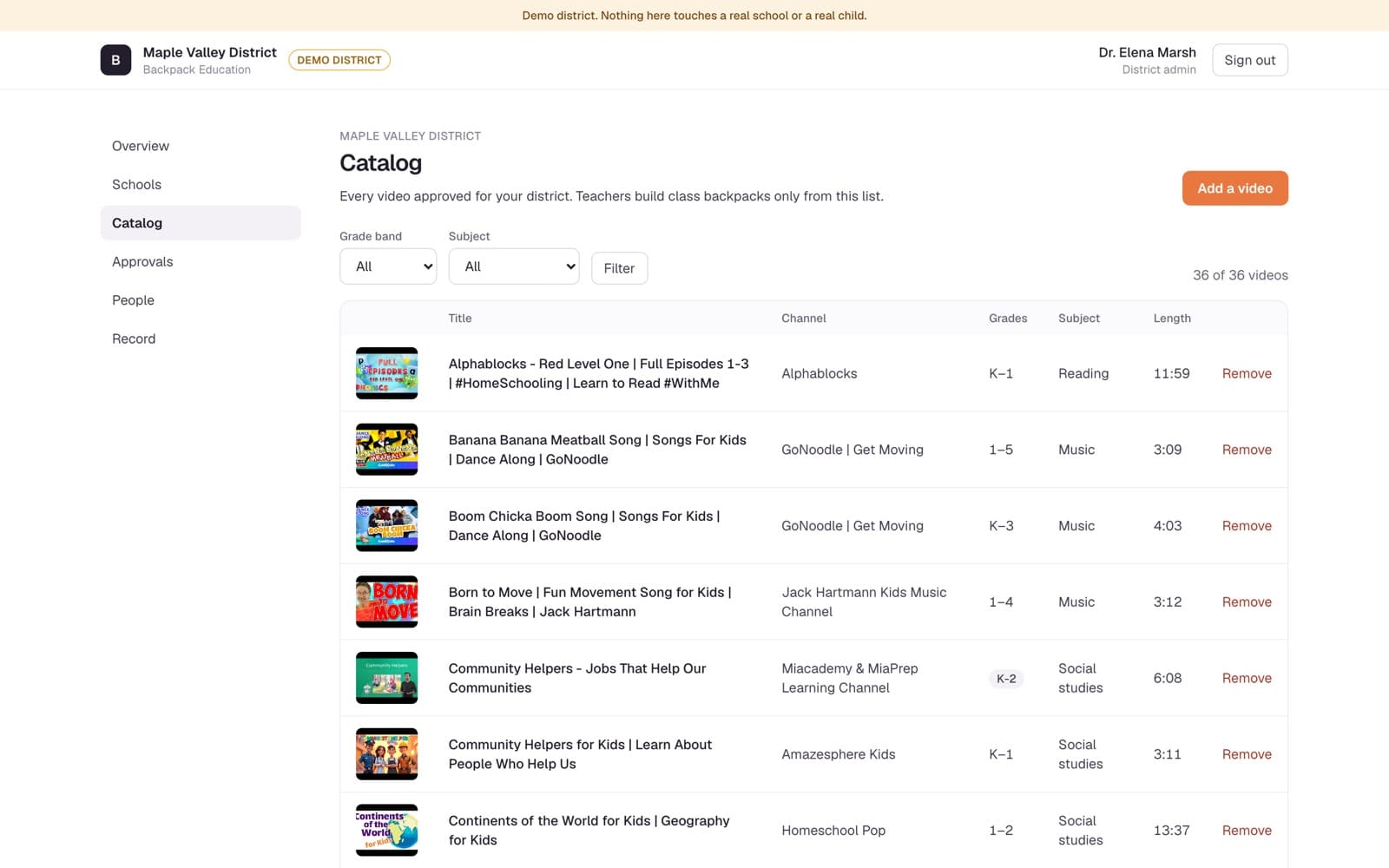
Maple Valley District catalog: Every video approved for your district, grade band and subject filters, 36 of 36 videos, each row with channel, grades, subject, length and Remove

1 · The district

The district keeps one approved list.

Each video is approved for a grade band and subject. Teachers choose only from this list, and removing a video takes it out of every class at once.

  1. 1Filter by grade band and subject.
  2. 2Remove takes a video out of every class backpack in one step.
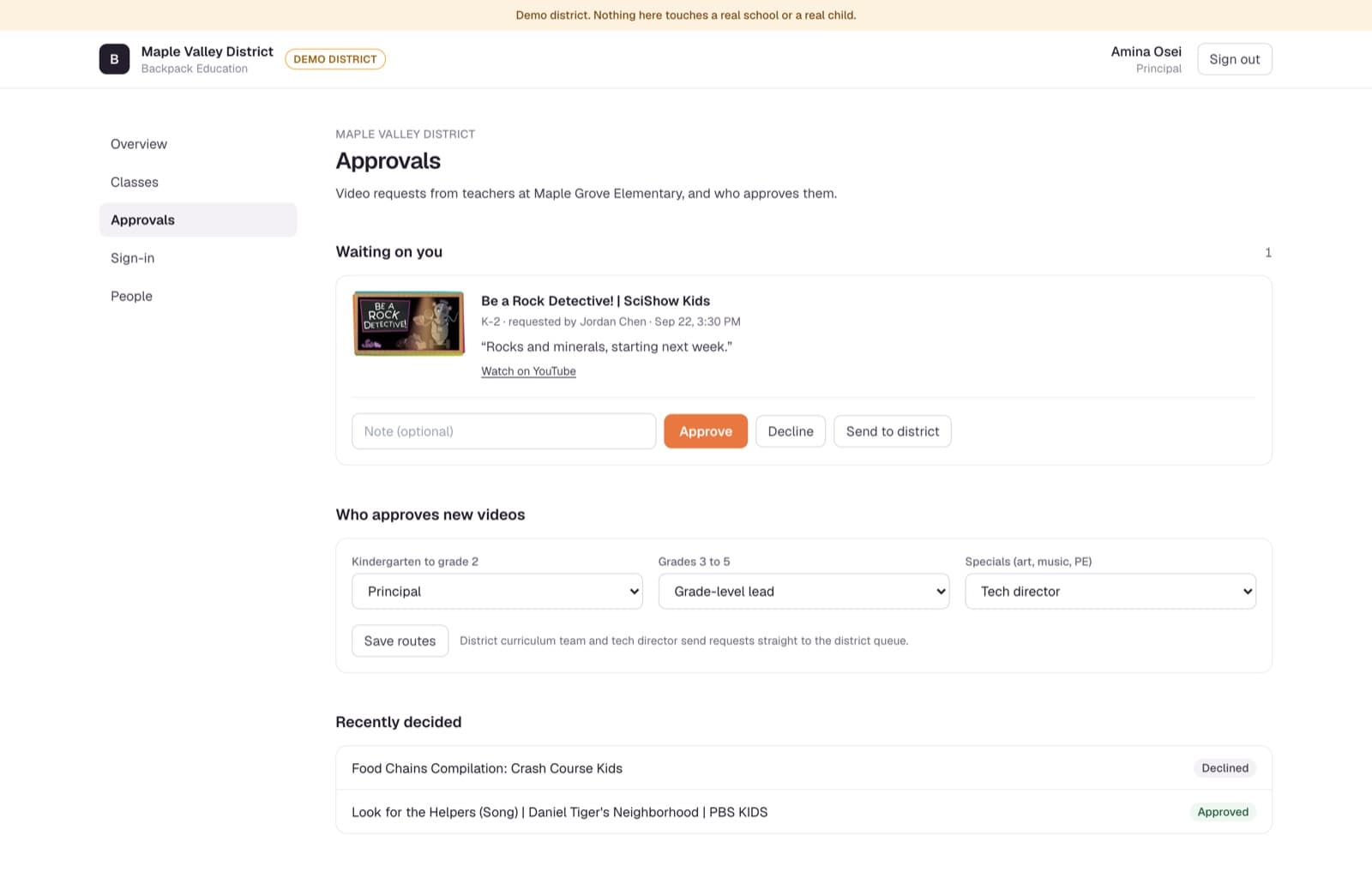
Maple Grove Elementary approvals: Be a Rock Detective, requested by Jordan Chen for K-2 with the note Rocks and minerals, starting next week, and Approve, Decline and Send to district

2 · The school

Each school chooses who approves new requests.

For each elementary grade band, the principal picks the principal, the technology director or the district curriculum team.

  1. 1A teacher's request arrives with their note.
  2. 2Approve, decline, or send it to the district.
Kindergarten, Reed: Open classroom tablet button and a class backpack of five videos, each with Up, Down and Remove

3 · The teacher

The teacher chooses and orders the videos.

Ms. Reed puts today's videos in teaching order, adds more only from the approved list, and opens a class tablet that shows exactly this list. We call this list the class backpack.

  1. 1Open classroom tablet signs the teacher out of this device first.
  2. 2Reorder or remove, or ask for a video that isn't there yet.
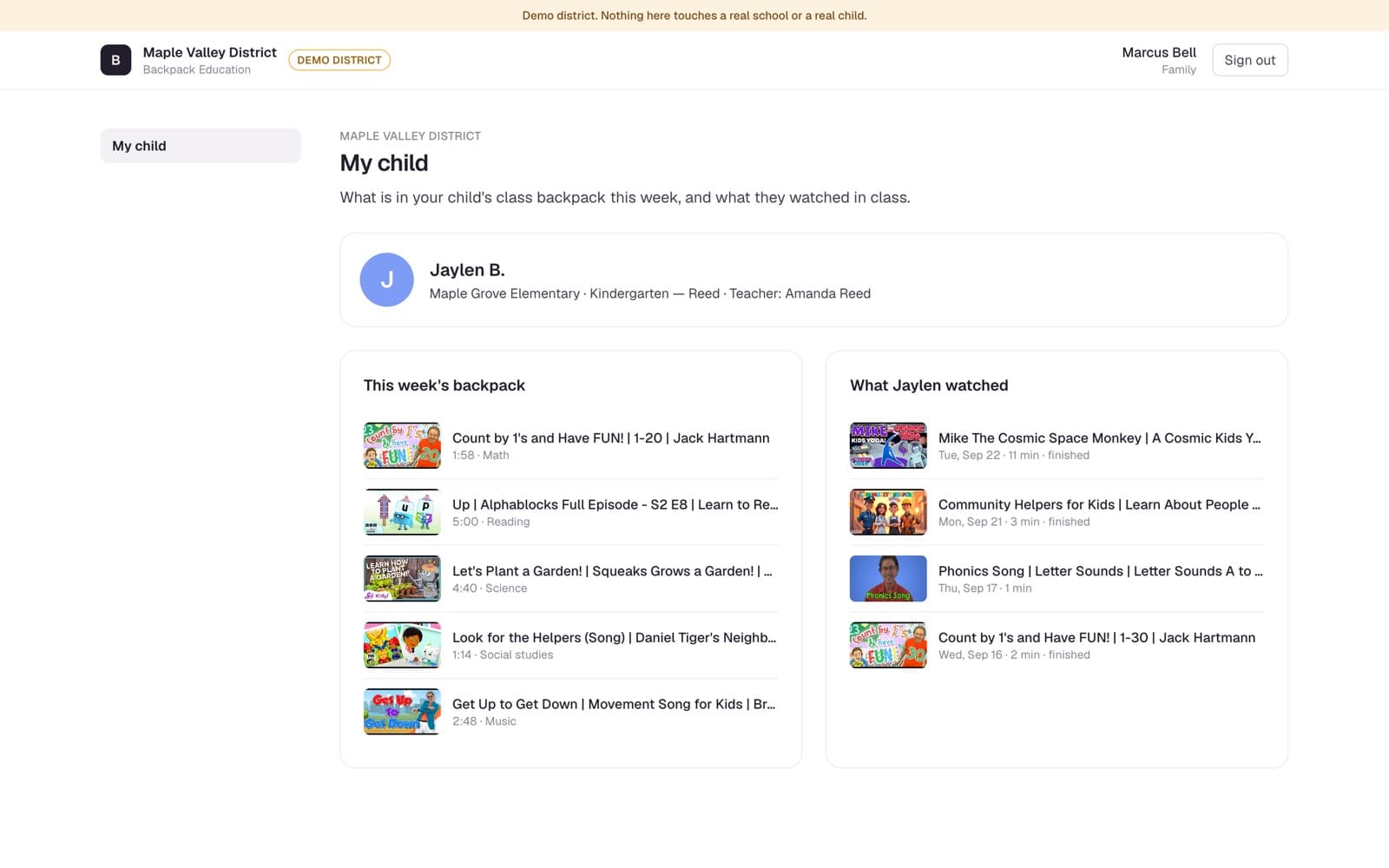
Parent's What Jaylen watched: four videos with day, minutes and finished

4 · The child and the family

Only the teacher and the family see what a child watched.

The teacher sees it for the class, and a parent sees it for their own child. No principal or district screen shows it; it leaves these screens only in the district's own data export.

  1. 1Each video, and the day it was watched.
  2. 2How long, and whether they finished.

See how it works, step by step

Kindergarten to grade 12

One approved list. A screen that fits each age.

Every class watches only what its teacher chose from the district's approved list. How students get to those videos depends on their age. A K-8 school uses two of these: the classroom tablet in its K-5 rooms, and class codes in grades 6 to 8.

K-5 · elementary rooms

A shared classroom tablet

The teacher opens the class tablet with one tap. Each child taps a tile with their first name, last initial and colour, then sees only the videos their teacher picked. There is no search, and Backpack never starts another video on its own. The only button goes back to the class list.

Grades 6-8 · a K-8 school or a middle school

A class code and their own list

The teacher opens a class session and shows a six-letter code, full screen on the projector if they like. Students go to education.backpack.kids/join, type the code and pick their name. They see the class videos with a due date, a one-line note from the teacher and, where the teacher chose one, the part of the video to watch.

Grades 9-12 · high school

The same join, a layout for older students

High school students join the same way and see every class they are in, in a layout the school chooses: a syllabus, a week-by-week timeline, a notebook or a dark screen built for video. Teachers can add optional review videos on a shelf, apart from assigned work.

  • Signing inNo student has an email, a password or a photo in Backpack, at any grade. In grades 6 to 12 the class code works for 90 minutes and the session ends at the end of the school day.
  • Display optionsText size, reduced motion, high contrast, a dyslexia-friendly font, large captions and a focus mode that shows one video at a time. A teacher or school leader can set them for one student. Captions are on by default.
  • LayoutsThe district and each school choose a layout for grades 6-8 and for 9-12. A school can let its own students change theirs.
  • What counts as watchedA student has watched a video when they have seen at least 90 percent of the assigned part. The teacher sees who has.

Questions

Questions we are asked

What grades is Backpack for?

Kindergarten to grade 12. K-5 classes watch on a shared classroom tablet the teacher opens. Grades 6 to 12 join with a class code the teacher shows, then pick their name. A K-8 school uses both, and a high school uses class codes.

Can a school customize who approves videos in the catalog?

Yes, for new videos. The district keeps the approved catalog, and teachers can use any video in it for their grade band without asking. When a teacher asks for a video that is not in the catalog, the principal decides who approves it, separately for K-2, 3-5 and specials: the principal, the technology director or the district curriculum team. The last two send the request to the district. Until the principal chooses, and for grades 6 to 12, requests go to the principal, who can approve, decline or send them to the district.

Does a teacher need approval for every video?

No. A teacher picks from videos the district already approved. Only a video that is not on the list needs a request, and the teacher's Requests page shows where each one stands.

How much time does it take a teacher?

About eight minutes a week to choose and order the week's videos, and one tap to open the classroom tablet or start a class session.

What devices does it need?

A web browser. Nothing is installed. In K-5 the teacher opens each tablet, it stays open for up to 12 hours, and a whole cart can run at once. The same page opens on the computer connected to the projector. Students in grades 6 to 12 can join from any school device with a browser.

How do students sign in?

K-5 children tap their own tile on the classroom tablet. Students in grades 6 to 12 type the class code and pick their name. No student has an email address, a password or a photo in Backpack.

What can families see?

A parent sees their own child only, read-only: the child's school, class and teacher, this week's class videos, and what the child watched, with the day, the minutes and whether they finished. This is the same for every grade, K to 12. Parents connect with the code on a family letter from the school, then sign in with a link sent to their email. Each school chooses whether a teacher, the office or nobody confirms a new family first.

What does Backpack keep about a student?

First name, last initial, a colour, grade, school, class, and which videos they watched, for how long and whether they finished. No photos, birth dates or home addresses. The district sets how long viewing records are kept and can export or delete its data.

Who can see what a student watched?

The teacher, for the class, and the family, for their own child. No principal or district screen shows it. It leaves those screens only in the district's own data export, and every export is logged.

Is student data sold or used for advertising?

No. Student data is never sold, rented or traded, never used for targeted advertising and never used to train AI models. We sign your state's student data privacy agreement before a pilot holds any real student data.

Are there ads?

Backpack shows no ads and tracks nothing for advertising. Videos play in the video host's own embedded player, which may show a short ad before some videos. Backpack does not choose those ads.

What does it cost?

A pilot in one school is free, with no purchase order. After the pilot, your district's price is written in the order form you sign.

Can I try it as a teacher before my school decides?

Yes. Start a free 14-day trial at education.backpack.kids/try with your school email address. You get one class of your own with ten sample students and a starter set of approved videos for your grade band. A teacher cannot buy Backpack; a school or district does. If your district signs up, what happens to your trial depends on its contract: it may be converted or phased out, and videos you collected can be moved into the district catalog. Nothing moves automatically.

See it for yourself. Open a demo district.

Sign in to the demo district as a district admin, principal, teacher, classroom tablet or parent and follow one video from approval to a child's tap. Or open a sample class as a teacher, with no form.

Backpack shows no ads and tracks nothing for advertising. Videos play in the video host's own embedded player, which may show a short ad before some videos. Backpack does not choose those ads. We sign your state's student data privacy agreement before any pilot. How we handle a child's data · See where your state stands

Classroom tablet, Kindergarten Reed: Who's watching? Tap your name to start. Five colour tiles: Ava P., Jaylen B., Leo M., Mia T. and Sora N.